



Press record,
press delete
How some Arizona school boards flunk Transparency 101
At least three Arizona school boards have acknowledged destroying recordings of their official meetings before the legally required retention period has elapsed, a practice that threatens transparency, and which legal experts say violates state law.
Beyond the legal requirement to retain the recordings, some school districts also don’t post the recordings they do make online. Without that public access, a parent who could not attend — whether because of work, a scheduling conflict, or because a last-minute meeting was scheduled — is left to decipher what happened from meeting minutes that can omit key details and sanitize what was actually said.
The Beam contacted 208 school boards across Arizona to determine whether they record their meetings and make recordings available online. The review combined public records requests, phone calls and independent research. Of those boards, 188 confirmed their practices.
The three districts that deleted their board meeting recordings early represent the most extreme examples of a disparity in how accessible school boards make their meetings. Some boards post every meeting on YouTube and others do not record their meetings at all, while a handful destroy recordings, in a move that keeps parents from accessing the full record of what was said during debates on matters that impact the education of their children.
Under Arizona law, recording is optional, but according to the state’s records retention schedule, which specifies how long public records must be kept, any recording that is made by school boards in Arizona for the purpose of creating or assisting in the creation of meeting minutes must be kept for at least three months .
Chris Thomas, an attorney and the director of legal strategy for education policy at the Goldwater Institute, has advocated for greater transparency into school board activity, including providing the public with recordings of board meetings.
“Minutes don’t capture everything that happens at the meeting,” Thomas said. “There’s body language, there’s inflection.”
The requirement to maintain meeting recordings for three months should be considered a minimum, he said, and districts should see value in keeping the recordings available even after the required period has passed.
“I say the retention schedule is a floor,” Thomas said. “I don’t understand why you would delete it. It’s there for posterity. It’s a moment in time. It helps tell your district’s story.”
Beyond the districts that delete their recordings, more than half of the districts contacted by The Beam either do not make recordings, or make recordings and choose not to post them online.
Twenty districts — each with 600 or fewer students — did not provide information about their recording policy.
Among the districts that make recordings and delete them earlier than the state’s required retention period, one of the largest is Tucson’s Amphitheater Unified School District, with more than 11,000 students .
The Beam presented the district with public records training materials, the state’s records retention schedules and opinions of attorneys with expertise in public records law.
“Moving forward,” Jen Anderson, the executive assistant to the Amphitheater Unified School District superintendent, wrote in an email, “if we do make a recording we will be retaining it for three months.”
Anderson did not respond to multiple emails asking whether the district will continue recording meetings.
Similarly, officials with Ash Fork Joint Unified School District and Heber-Overgaard Unified School District – two small, rural districts in northern Arizona – also told The Beam that their board meetings are recorded, but then deleted.
When informed by The Beam that this practice may conflict with state records retention policies, officials from Ash Fork told The Beam they would change the district’s process and will keep recordings for three months. Officials from Heber-Overgaard did not respond to multiple emails asking whether the district would record future board meetings.
What the law requires
Under Arizona law, school boards must choose to produce either written minutes or a recording of board meetings, and either must be available for public inspection within three working days.
When recordings are made for the purpose of creating minutes, they must be maintained for three months, according to Record Series Number 10262, “after date of meeting and after minutes transcribed or summarized and approved.”
According to Nick Bacon, a staff attorney with the Arizona Ombudsman-Citizens’ Aide, a state agency that fields complaints and advises the public on Arizona’s public records and open meeting laws, “Record Series Number 10262 applies to recordings made by public bodies subject to Open Meeting Law, when the recordings are made for the purpose of assisting in the creation or transcription of minutes.”
The requirement is explicitly stated in the Open Meeting Law guide produced by the ombudsman’s office for training public officials about the law, Bacon noted.
Bo Dul, an attorney with Coppersmith Brockelman who previously served as general counsel to Arizona Gov. Katie Hobbs, wrote in an email to The Beam that the law is clear: “the recordings should be retained for 3 months after the date of the meeting and after minutes are transcribed, summarized or approved.”
How a small district makes recordings on a small budget
High-end video and audio recording equipment can cost tens of thousands of dollars. A middle-of-the-range setup might set a district back a few hundred dollars. A budget webcam can be purchased for less than $50.
Any of those, plus a YouTube account, is enough to record school district board meetings and post the videos online. The most determined of districts could probably even do it using a cellphone.
Some districts have figured out how to make it work, even on tight budgets and with small staffs.
Joseph City Unified School District, about an hour east of Flagstaff and serving just 422 students, is an example of a small district that livestreams and archives its school board meetings on YouTube. The rural district has been recording meetings for a decade and posting them on YouTube since the COVID-19 pandemic.
Steve Mills, the district’s business manager, described a concern he had when the district began streaming meetings on YouTube: that some board members might act performatively, and that other members would be afraid to speak up. But, he added, “neither end of that spectrum really materialized.”
The increased transparency, Mills said, has strengthened community relations.
“I think we get less complaints now about things the board is doing,” he said.
Members of the public are invited to come to meetings, Mills said, “and if you can’t come to the board meeting, click the link and you can watch it. So that’s not on us, that’s on you.”
Joseph City Superintendent Bryan Fields said in an email that recording “is a risk to us because we are far from perfect.” But, he said, the practice can have a positive impact by adding to the “motivation to keep things formal.”
The district used a grant to invest in recording technology, Mills said, but sophisticated equipment is not a prerequisite, stressing that audio quality is the main concern.
“You don’t have to have this super three-camera angle video or whatever,” he said.
Discretion means transparency can be pulled back
Once school districts meet the minimum requirements of state law by posting meeting minutes, the law provides them latitude that can lead to less transparency.
Jessica Allen, whose children attend the Sanders Unified School District, about 30 miles east of the Joseph City Unified School District, found this out firsthand. Allen tries to attend school board meetings in person. But sometimes, attending in person hasn’t been an option for her, when, for example, she has been traveling for work or attending one of her kids’ sports games.
Because the district made the meetings available over Zoom, Allen had still been able to monitor and even participate in the meeting virtually.
But when Allen pulled up the district website on May 12, she said, looking for a Zoom link for a board meeting scheduled just one day earlier, she couldn’t find it. When she reached out to the district, Allen said she was informed that the Zoom option implemented during the COVID-19 pandemic was no longer considered feasible.
“I just don’t understand how it’s not feasible,” Allen said, “and how it’s not seen as a benefit to the community that the school serves.”
The Sanders Unified School District did not respond to questions about why the Zoom option was removed.
“If a parent has a complaint, SUSD has a complaint process that parents and others can follow,“ Kenneth Cooper, the district’s director of human resources, wrote in an email.
“It’s not easy for a member of the public, a parent, a taxpayer, to attend a school board meeting,” the Goldwater Institute’s Chris Thomas said. “They’re often not at convenient times.”
Thomas and the Goldwater Institute have endorsed the practice of creating video records that can give a full picture to members of the public who cannot attend.
“Minutes are not a transcript of what everybody says. They’re a summarization of what happened and what the discussion was and there’s a lot of license in terms of capturing that. So I think nothing is better than a video recording of it,” Thomas said.
In one example, a board member of the Littlefield Unified School District, during the public comment period of a November 2025 meeting, read a letter that accused the superintendent of directing investigations into a principal and a teacher based on personal vendettas.
“The repeated investigations appear to stem not from legitimate concerns, but from a personal vendetta held by the superintendent,” the letter said, explicitly identifying the district superintendent.
But when meeting minutes were published, they included a sanitized version of the comments, without identifying that the board member’s remarks were directed at the superintendent.
The meeting minutes noted only that “these actions appear motivated by personal grudges rather than student welfare,” without any mention of the superintendent.
Additionally, Thomas pointed out, board meetings can stretch for hours. And boards sometimes place the most contentious items at the end strategically, he said, demanding more endurance than members of the public might expect.
“These meetings can be four or five hours and you may be there for just one thing,” Thomas said. “And oftentimes they will save the most controversial things to the end of the meeting just to kind of wait everybody out.”
With recordings, Thomas said, “you get to see it all, warts and all.”
Where minutes are all the public gets
Roughly one-third of district boards don’t record their meetings at all, opting to satisfy state law with written minutes alone. Larger districts more commonly record their meetings, and post the recordings online, compared to smaller districts.
But there are exceptions.
Glendale Union High School District is one of the largest public high school districts in the state, with 15,500 students. The district does not record its board meetings.
Avondale Elementary School District, with more than 6,000 students, also does not record its board meetings, despite the fact that the district maintains a YouTube channel for other media.
“Minutes don’t capture everything that happens at the meeting. There’s body language, there’s inflection.“
— Chris Thomas, Goldwater Institute
In smaller districts, the absence of recordings is more common. Pima Unified District has a little more than 1,000 students and does not record school board meetings.
“We don’t get big attendance at our board meetings,” Stephen Estatico, the Pima district superintendent, said. “So we don’t feel there’s a need to do anything other than provide those minutes.”
Kristin Turner, the superintendent of the Paloma Elementary School District, with just 100 students, shared a similar view. She said by email they have not considered recording meetings “because we have never heard of any interest.”
Where districts make recordings, then delete them
Three districts told The Beam they record their board meetings for the purpose of creating minutes, only to delete them afterward. According to the state’s three-month retention requirement, those recordings should have been kept.
Ash Fork Joint Unified School District records board meetings solely to generate minutes, and deletes the recording afterward.
Sue Atkinson, the district’s business manager, cited hardware constraints as the reason for this practice.
“We utilize a handheld recording device with limited storage capacity,” she said. “Once meeting minutes are transcribed, the recordings are deleted to allow space for future use.”
After The Beam informed Atkinson that the practice conflicts with state records retention policies, the district’s leadership decided to change their process.
“Our Board meetings are now also available through Zoom,” Atkinson wrote in an email, “and those recordings can be kept for 3 months to comply with records retention.”
A district that livestreams on YouTube, and then deletes recordings
Vail Unified School District, which serves more than 15,000 students in southeast Tucson, is the only district that livestreams board meetings on YouTube and then deletes them. Because the district did not say it uses the recordings for minutes, it does not appear to be in violation of state law.
After The Beam shared the retention policy with the district, Superintendent John Carruth wrote in an email that Vail would begin making audio-only recordings to assist in creating transcripts, which will be kept for the required retention period.
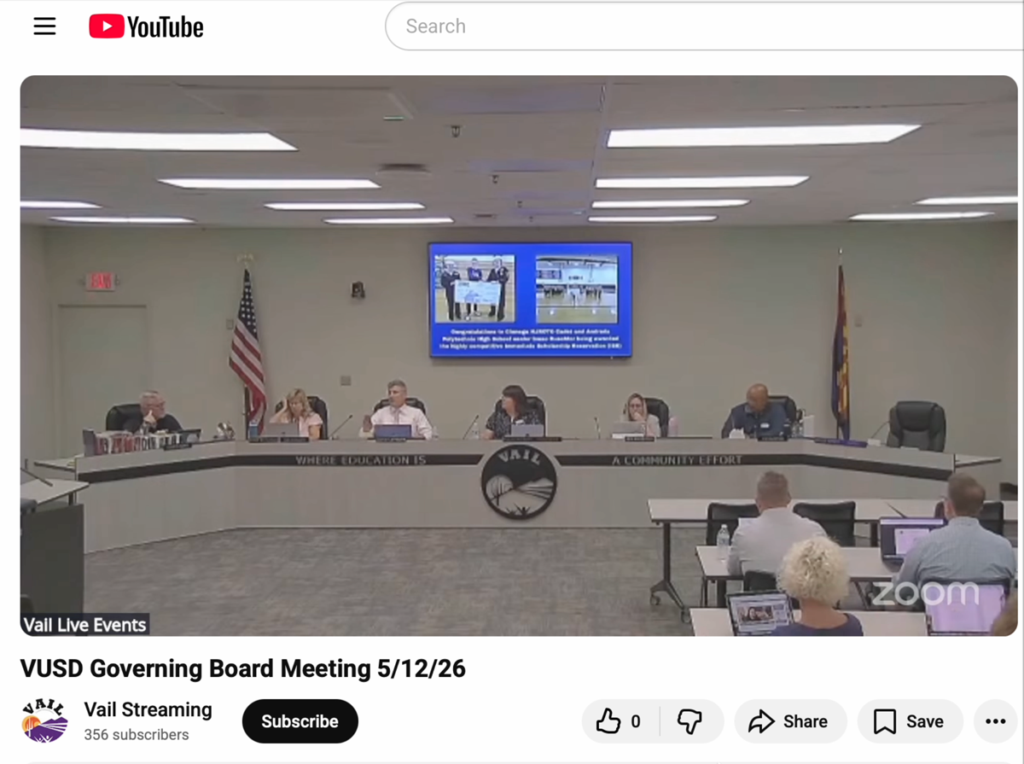
“Our practice of live-streaming the meetings via YouTube will continue for the sole purpose of providing remote access by the public,” he continued. “The videos are not intended for, nor will be used to assist in the creation or transcription of the minutes of the meeting. As such, the videos will not be retained once the meeting has concluded.”
When asked why the district would not simply leave the videos up, Carruth did not give a response.
A proposed law would require recordings
During the current legislative session, Arizona lawmakers approved a bill that would require most school boards to livestream and record their governing meetings, publish the recordings online and maintain them for at least five years, in addition to restricting how and where school board meetings can occur. The requirement to record board meetings and longer retention period found in House Bill 2380, sponsored by Republican Rep. Matt Gress, would apply to any district with more than 250 students, accounting for about 97% of all students in the state.
“I think being able to have the video,” Gress said in an interview with The Beam, “and to go back and look at the record and what was discussed is incredibly important and will be insightful for taxpayers.”
When presented with The Beam’s findings, Gress said it was troubling to learn that the requirement to keep recordings for at least three months was not always followed.
“It just engenders more distrust of institutions in general,” Gress said.
And a district learning that their practices might have violated what the law requires, then deciding not to record their meetings in the future, he added, is a move in the wrong direction.
“I do think it’s troubling,” he said, describing what he said was a perception that maintaining recordings for three months is so inconvenient, “that they might just get rid of recording the meetings altogether. So there it seems like they’re kind of going backward.”
HB 2380 was passed by Arizona lawmakers along strictly partisan lines, with support coming only from Republicans. Democrats opposed the bill, citing provisions of the bill unrelated meeting requirements.
The bill would also require Arizona school district governing boards to hold meetings in public facilities within the district, allow board members to remove items from consent agendas — bundled items routinely voted on as a bloc — before a vote; require public roll-call approval; and require detailed cost and purpose disclosures for out-of-state travel.
The bill awaits a final vote in the chamber where it originated to approve the amendments made to it.
Lizzie Tomlin, an investigative reporting intern for The Beam, contributed to this story.