



By Katie Wilcox
The politically divisive Proposition 320 asks voters to decide whether many Arizona public school districts should spend 60% of their annual operational spending on instruction or face a steep financial penalty: a reduction in classroom site funds.
The classroom site fund provides more than $1 billion to Arizona school districts and charter schools, primarily for teacher pay. Proposition 320 would not apply to charter schools.
The Beam – at Arizona State University’s Howard Center for Investigative Journalism – analyzed data from the Arizona Department of Education and the Arizona Auditor General and found that districts subject to the measure received nearly $700 million in classroom site funds in fiscal year 2025.
Using the state’s fiscal year 2025 totals, The Beam calculated the amount of money 87 school districts would have to reallocate in a single year or face a 25% reduction in classroom site funds.
Key Takeaways: What Proposition 320 would require if passed
- The ballot measure applies to all districts in counties with more than 500,000 residents — Maricopa, Pima and Pinal, based on the latest census estimates. It also applies to rural districts with at least 7,500 students.
- The Beam identified 90 public school districts that would be subject to Proposition 320. Those districts enroll more than 700,000 students, a majority of all students in Arizona.
- The Arizona auditor general listed 88 of the 90 affected districts as spending less than 60% of their operational spending on instruction in fiscal year 2025, but one district did not include actual spending data.
- Combined, the 87 districts with available data spent 52.5% of their operational spending on instruction, or about $4.6 billion, in fiscal year 2025.
If passed, Proposition 320 would require the 87 districts to reallocate an estimated $42.8 million toward instructional spending in a single year, according to The Beam’s analysis, or risk losing $173 million in classroom site funding, subject to limited waivers.
Proposition 320 would not require districts to meet full compliance in the first year.
Instead, the measure would mandate annual increases of half a percentage point in the share of operational spending devoted to instruction, with limited waivers available.
Districts that fail to increase that share by half a percentage point annually until reaching 60% could lose classroom site funds, beginning with a 25% reduction. That reduction would increase with continued noncompliance and could reach 100% after four years of noncompliance, barring any waivers.
Most districts spend less than 60% of operational spending on instruction
Proposition 320 uses “instructional spending” as defined by the state auditor general. The auditor general’s definition includes expenses such as teachers, teachers’ aides, substitute teachers, supplies, athletics and field trips.
Instructional spending does not include “student support services” such as speech pathologists, nurses, social workers and counselors, though state law allows classroom site funds to pay for student support.
Other operational spending categories include administration – salaries for principals, superintendents, human resources employees and other administrators – as well as transportation, food service and plant operations, including heating, air conditioning and lighting.
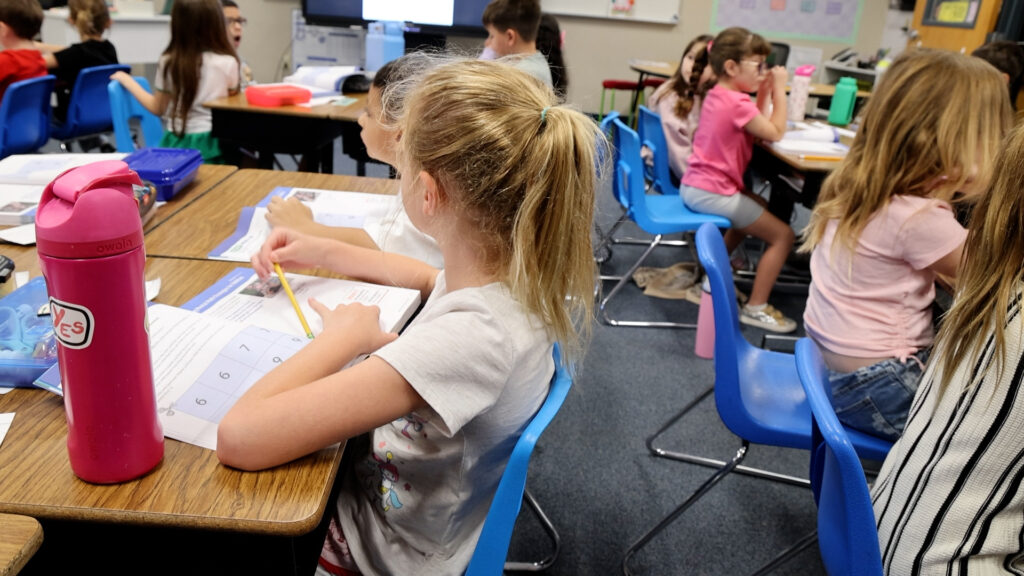
Glendale Elementary School District Assistant Superintendent Mike Barragan said Proposition 320 could force districts to make cuts that could undermine other key positions.
“The question becomes, as a state, do we believe that nurses and OTs and PTs don’t play a critical role in special education, which allows or helps that student be ready for the classroom,” Barragan said.
Glendale Elementary School District spent 49.8% of its operational spending on instruction, according to the latest data.
Using fiscal year 2025 totals, the single-year requirement would have meant increasing the district’s instruction spending share to 50.3%, reallocating about $520,000 towards instruction.
If Glendale Elementary had failed to make that shift, The Beam calculated the one-year penalty would have been a $1.9 million reduction in classroom site funds.
Barragan said older buildings can increase plant operation costs and that facilities spending is already underfunded. He said any reduction in funding would be “digging a bigger hole.” The district has faced years of declining enrollment, resulting in lower funding, and has closed five schools.
“I think you’re moving the goal post,” Barragan said.
Reducing and reallocating classroom site funds
For supporters of Proposition 320, the potential for reduction in classroom site funds provides a powerful financial incentive for compliance.
“This isn’t a punishment, this is a deterrent,” said Matt Beienburg, director of education policy for the Goldwater Institute. The Phoenix-based, right-of-center think tank supports Proposition 320. Beienburg said that the law is clear that the classroom site fund is meant to supplement, not supplant, money for teacher salaries.
He said auditor general reports have shown administrative costs rising faster than teacher salaries and that Proposition 320 would ensure funding goes where it was intended under the law.
“It just says instruction is the core fundamental purpose of the schools,” Beienburg said. “All these other things matter; nurses, counselors, instructional support, facilities, transportation. But the first chief goal of the district is to provide high quality instruction.”
Opponents said reducing districts’ classroom site funds would make it even harder to increase instructional spending.
Jimmy Arwood is the government relations director for Arizonans for Quality Education, an advocacy group that opposes Proposition 320.
“This proposition is so poorly written that we are literally talking about slapping school districts with a cut to teacher pay and teacher positions as the punishment for not moving more dollars towards instruction,” Arwood said, adding that the ballot measure does not guarantee teacher pay increases.
Arwood said that without additional funding, districts would have to cut programs to move money to instruction.
“What this means is that students are going to lose services that they need,” Arwood said. “Students are going to lose counselors and nurses that they depend on, teachers are going to lose their school safety officers, their school social workers.”
Compliance would occur gradually, but both Arwood and Beienburg said it could become more difficult year after year.
If a district does lose some or all of its classroom site fund allocations under Proposition 320, the money would be reallocated to other districts and charter schools.
Proposition 320 does not impose spending requirements on charter schools
Charter schools receive classroom site funds but would not be subject to Proposition 320’s instructional spending requirements. Charter schools are publicly funded schools operated by independent organizations, including private businesses.
In June, the Arizona Legislature passed a concurrent resolution referring Proposition 320 to the ballot.
During a state Senate floor vote in March, Democratic state Sen. Mitzi Epstein of District 12 challenged the measure’s sponsor, Republican state Sen. Jake Hoffman of District 15, to explain why charter schools would not have to limit administrative budgets or increase instructional spending.
Hoffman said charter schools are “not material” to the measure, adding that “charter schools are a market-based education solution, meaning parents go to charter schools if those charter schools are delivering the things that they want.”
He also said that public schools are “government-run.”
“Therefore, it is right for us to tell those government-run institutions that they must be better with their money, and they must direct the money to the places that this legislature intended when it appropriated them,” Hoffman said.
Epstein disagreed.
“Why, oh why are they only cutting money from district schools?” Epstein said. “Charter schools will not be affected. ESAs will not be affected. But district schools would be cut, and we’re sick and tired of the cuts from that side of the aisle.”
The resolution passed without the support of a single Democratic lawmaker in the state House or Senate.