



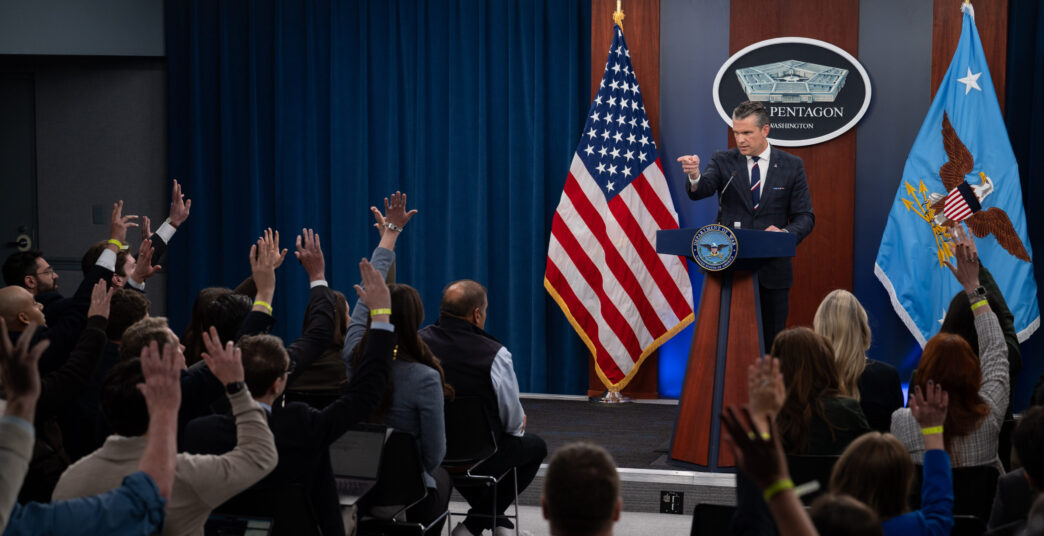
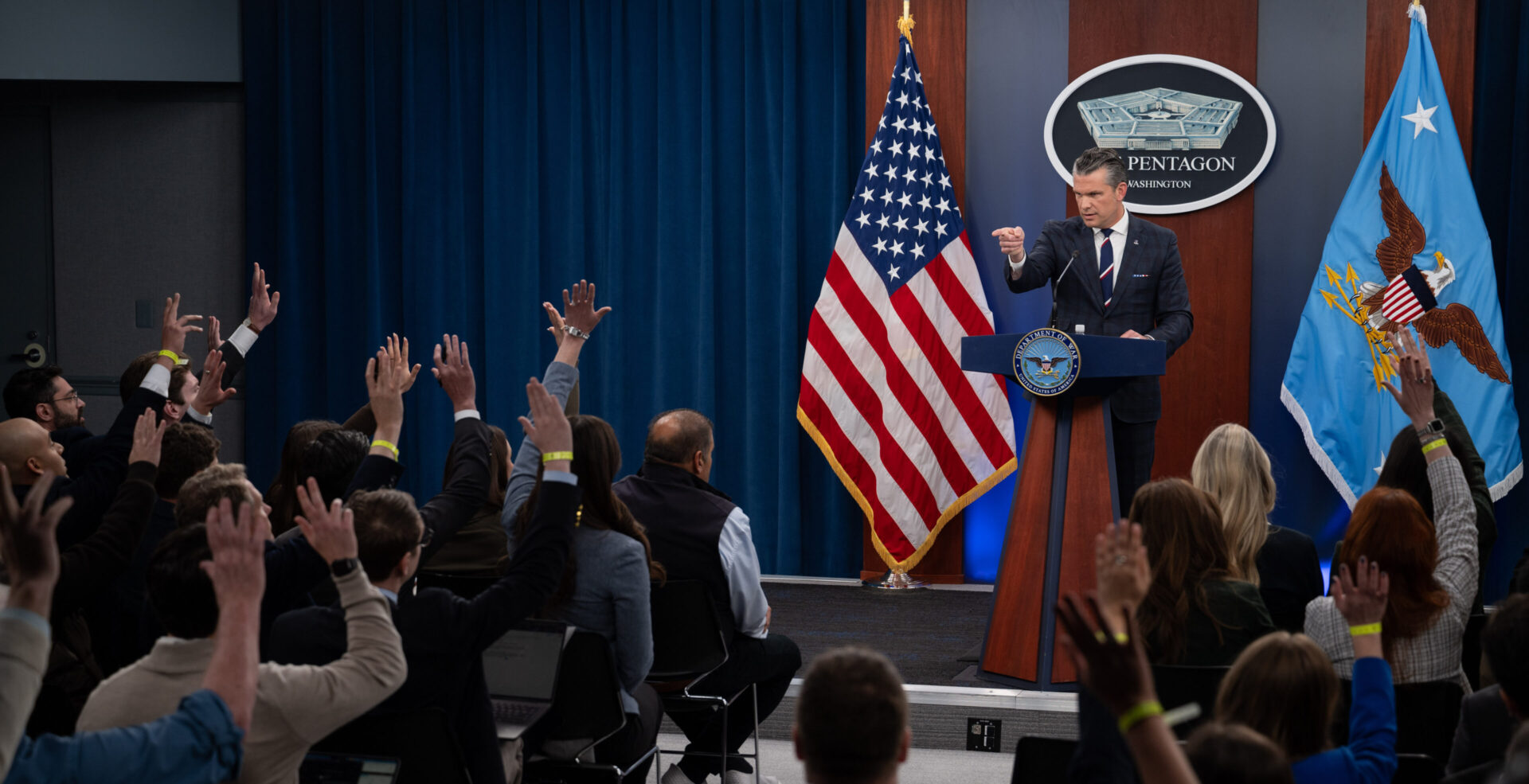
WASHINGTON – One of Defense Secretary Pete Hegseth’s most forceful arguments against the effort to impeach him was that if the House accuses him of war crimes, that would open the door to prosecuting rank-and-file personnel.
“Put the secretary on trial today, and the men and women who carried out those orders tomorrow,” he said at a Pentagon news conference on Nov. 10.
Experts in military law agree – somewhat. Senior officials who knowingly ordered unlawful killings could face criminal exposure, they say, but the vast majority of personnel involved were in no position to question their orders.
“It’s complete deflection,” said retired Air Force Lt. Col. Rachel VanLandingham, a professor at Southwestern Law School in Los Angeles and a former Air Force judge advocate. “There’s a line between those senior military leaders and everyone else that was simply executing orders.”
What should front-line personnel do when confronted with an illegal order? What about an order they’re not sure about? The impeachment effort and Hegseth’s rebuttal revived such questions – the sort that hung over the post-World War II Nuremberg trials and Army Lt. William Calley Jr.’s trial for the My Lai massacre.
The 34-page impeachment resolution from Rep. Thomas Massie, a Kentucky Republican, accused Hegseth of ordering “extrajudicial killings” in the military’s strikes on suspected drug boats, saying they amounted to “the summary execution of at least 243 persons.”
House Republicans quashed the impeachment push on Nov. 10, sending it to a committee chaired by Rep. Jim Jordan, R-Ohio, the incoming minority leader and an ardent ally of President Donald Trump.
The resolution does not ascribe knowing criminality to anyone besides Hegseth in the killings of purported drug smugglers at sea, including strikes that killed shipwrecked survivors.
In fact, it casts his subordinates as victims, asserting he used “false legal authorities” to compel them to carry out the strikes.
“Politicians in Washington have accused the sailors and the pilots who struck narco-terrorist boats of war crimes for doing their job,” Hegseth countered at his news conference. “Senators in cute videos have suggested the same.”
Six Democratic lawmakers with military or CIA backgrounds posted a video Nov. 18, 2025 reminding service members of their duty to refuse unlawful orders.
Retired Army Lt. Col. Geoffrey Corn, chair of criminal law and director of the Center for Military Law and Policy at Texas Tech University School of Law, called it “invalid” to conflate impeachment with legal peril for uniformed personnel.
“Impeachment is a political act” and not any sort of “predicate to prosecution of subordinates,” he said by email.
Besides, he said, the executive branch’s assertions of legality would make it awfully hard to prosecute anyone: “Obedience to an order – even if it turns out that order was unlawful – is a complete defense unless the order was ‘manifestly’ or ‘clearly’ unlawful.”
Four of the eight articles in Massie’s impeachment resolution concern the Iran war, including alleged violations of the 1973 War Powers Resolution, which sets deadlines for withdrawal of troops without congressional approval.
Subordinates, Corn said, face no plausible legal peril under that statute.
“The real issue here,” he said, is that the secretary of defense “endorsed military operations of such dubious legality – or some would say such obvious illegality – that it put service members in a terrible situation.”
What orders must troops refuse?
The first operation against a boat in the Caribbean, on Sept. 2, 2025, ultimately killed all 11 people aboard. Two who survived the initial strike were clinging to the wreckage when U.S. forces killed them in a follow-up strike more than a half-hour later.
The Justice Department’s Office of Legal Counsel issued a still-classified memo three days later that, according to the administration, affirmed the legality of the ongoing operation. A White House notice to Congress invoked presidential war powers on the basis of “armed conflict” with drug cartels designated as terrorist organizations.
On Nov. 28, 2025, The Washington Post reported that Hegseth gave a verbal directive before the operation began to “kill everybody,” and that Navy Adm. Frank “Mitch” Bradley, head of Special Operations Command, ordered the second strike after a drone feed showed two survivors.
Hegseth posted on X that day that the report was “fabricated, inflammatory, and derogatory” and that the operations are lawful “and approved by the best military and civilian lawyers, up and down the chain of command.”
He later said he left after the first strike and didn’t see the second. The White House said Bradley ordered the second strike “within his authority and the law.” Bradley told lawmakers at a classified briefing on Dec. 4, 2025, that Hegseth never issued an order to leave no survivors.
An order to kill shipwrecked survivors would be “clearly unlawful and obedience would offer no defense to a homicide charge,” Corn said, though he emphasized that there’s no proof such an order was issued.
At his Nov. 10 news conference, Hegseth denied any illegality, calling the articles of impeachment “a farce. They mock the Constitution, they attack the chain of command, and they criminalize the warfighters who execute lawful orders.”
“The only people who target civilians are the terrorists that we hunt,” he said, adding that “we will not apologize for stopping the flow of drugs that kill our citizens.”
Adam Isacson, director for defense oversight at the Washington Office on Latin America, a human rights group, said that in his view, “the drone operator or gunner who took out the civilian boat did participate in a murder.”
But, he said, they “were told by DOD’s civilian leadership that they were defending the U.S. against violent terrorists.… They’re not off the hook, but not very exposed, either, since their only real option would have been to resign.”
Eugene Fidell, founding president of the National Institute of Military Justice and co-author of numerous books on military justice, also described the boat strikes as murders.
A drone operator could refuse an order, ask to see the legal justification or take the order up the chain of command, said Fidell, a visiting lecturer at Yale Law School and a former Coast Guard judge advocate. But “if the order calls for immediate compliance, you’re really in a jam.”
He called it “reprehensible” for Hegseth to avoid accountability by “hiding behind the members of the military.”
“He’s using them as human shields,” Fidell said. “I have no doubt that many people in uniform have had real heartburn over this situation.”
Legal precedents
A case that laid the legal foundation for the Nuremberg trials – and the principle that following orders doesn’t automatically absolve a subordinate – involved the sinking of the Canadian hospital ship Llandovery Castle in 1918. After the war, a German court convicted two junior U-boat officers who had obeyed orders to fire on and ram lifeboats.
A precedent cited more often in modern war crimes cases stemmed from the 1944 sinking of the Greek steamer Peleus in the Atlantic. The U-boat captain ordered his crew to machine-gun and throw grenades at survivors in the water and in life rafts. A British tribunal convicted him and four crew members who invoked the superior orders defense. The captain and two others were executed.
The Calley case during the Vietnam War served as yet another warning about patently illegal orders.
On March 16, 1968, Calley’s platoon and others in Charlie Company killed hundreds of unarmed villagers at My Lai – 347, according to the Army, though Vietnamese estimates topped 500. The victims included elderly people, women, children and infants.
Calley testified that his commanding officer had ordered him to “waste them,” and he had been trained “that all orders were to be assumed legal.” The commanding officer denied that and was acquitted. Three years after the massacre, a court-martial found Calley guilty and sentenced him to life in prison at hard labor, later reduced to 10 years.
The U.S. Court of Military Appeals, upholding Calley’s conviction, acknowledged in December 1973 that “in the stress of combat, a member of the armed forces cannot reasonably be expected to make a refined legal judgment” on a disputed issue. But even “the most ignorant” soldier “must be presumed to know that he could not kill the people involved here.”
No one else was convicted for My Lai. The Army secretary paroled Calley about three and a half years into his sentence in November 1974. A federal judge had thrown out the conviction, citing pretrial publicity and other grounds. An appeals court later reinstated it, noting that if defendants could avoid trial because of pretrial publicity, “truly heinous or notorious acts would go unpunished.”
VanLandingham views the boat strikes as acts of murder because “there was no war” and the victims “don’t pose an imminent threat.”
But, she said, there’s a critical distinction between egregiously unlawful and legally debatable orders.
“Service members have a duty to disobey orders in only two situations: one, they know they’re unlawful, or two, the orders are so manifestly, patently unlawful they should have known. And that’s a really high bar,” she said.
Prosecuting service members who’d been told that lawyers blessed the operations? “Good luck with that,” she said, adding that unlike Calley, “I think they can fall back on the superior orders defense.”
Minab school attack
Article IV of Massie’s impeachment resolution centers on the U.S. Tomahawk missile strike in Minab, Iran, that destroyed a school for children ages 6 to 13 on Feb. 28, in the first hours of the war.
Iran reported at least 156 deaths, including 120 children and 26 teachers.
According to a United Nations fact-finding report issued in September, the site had been operating as a school since 2016, in a walled compound that clearly separated it from an Islamic Revolutionary Guard Corps naval complex next door.
Satellite images from before the strike appeared to show children in the courtyard, the report said, and photos showed a playground and school signage.
The Pentagon has not released its review of the incident. An initial inquiry blamed outdated intelligence.
“Nobody did that on purpose,” Trump said in June at a Group of Seven summit in France.
The U.N. report said there are “reasonable grounds to believe” the strike amounted to “the war crime of making a civilian object the object of an attack” and that relying on outdated targeting information showed “recklessness.”
The report pointed to Hegseth’s decision in early 2025 to dismantle civilian-harm safeguards. The impeachment resolution makes a similar argument.
But the personnel who executed the Minab strike wouldn’t typically have a reason to question an approved target.
“I worked at headquarters in U.S. Central Command. We don’t rely on two-year-old data…. Never mind almost 10-year-old data,” VanLandingham said, adding that for anyone with command authority who “knowingly relied on outdated data … that’s involuntary manslaughter.”
That is the flaw in Hegseth’s warning that troops could be prosecuted “tomorrow,” the experts said: Legal exposure is generally highest at the top, but it turns on what each person knew and whether an order was clearly unlawful.
A future administration could prosecute, and there is no statute of limitations for murder in federal or military law.
But, Fidell said, “it’s probably an academic question, because I assume that our president will pardon everybody.”