



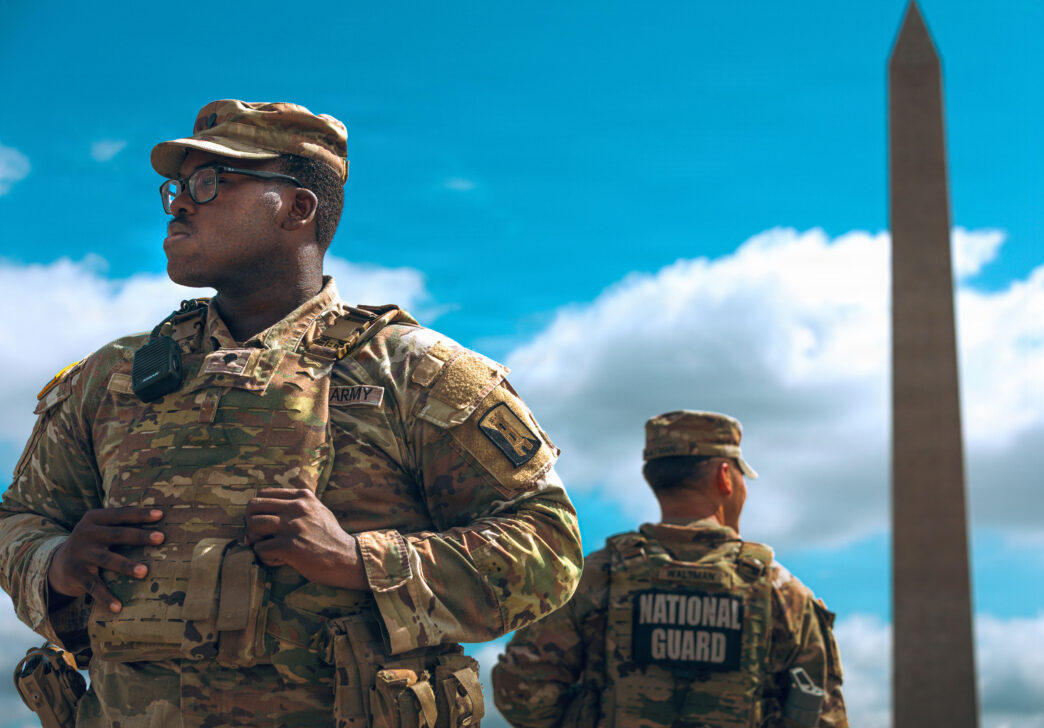
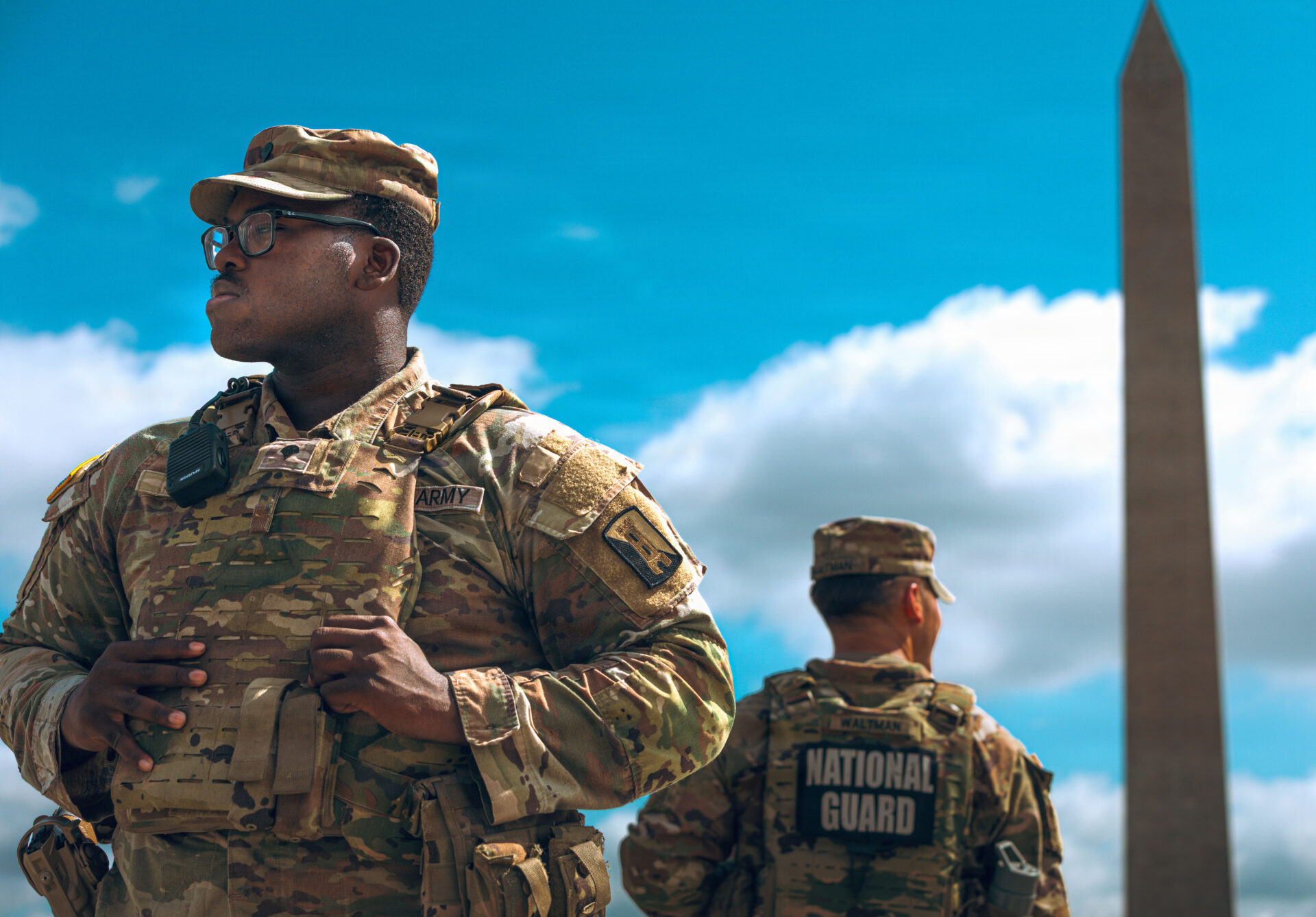
WASHINGTON – The White House has made sweeping claims crediting a huge decline in crime in Washington to the deployment of the National Guard and a surge of federal law enforcement.
“Crime is down 88% and our capital is shining again,” President Donald Trump asserted at this year’s White House Correspondents’ Dinner. “We have almost a crime-free city. Our National Guard has done an incredible job.”
About two weeks after the dinner, the deployment reached its first birthday.
“Under President Trump’s leadership, violent crime has been smashed to levels not seen in decades. Homicides have plunged. Carjackings, robberies, and overall crime have dropped sharply,” the White House said when it marked the anniversary.
Crime data from the city’s Metropolitan Police Department analyzed by The Beam does show that homicides, robberies and property crime fell in the 12 months after the intervention began in August 2025.
But those and other crimes had already been dropping – over the previous 12 months and over the previous decade, with the violent crime rate in 2025 about one-third lower than in 2016.
And similar declines occurred in most big U.S. cities, nearly all of which had no federal deployment.
In the 12 months before the deployment, violent crime in D.C. plummeted 30% compared with the previous 12 months, according to MPD data. Homicide fell by 23%, the data shows. Robbery dropped by 32%.
In the final days of the Biden administration, the Justice Department touted a 30-year low in violent crime in D.C. Over the next seven months, crime continued to decrease in numerous categories, including homicide, robbery, assault with a dangerous weapon and assorted property crimes.
Still, on Aug. 11, 2025, Trump announced he was deploying the National Guard and placing MPD under temporary federal control to “rescue our nation’s capital from crime, bloodshed, bedlam and squalor.”
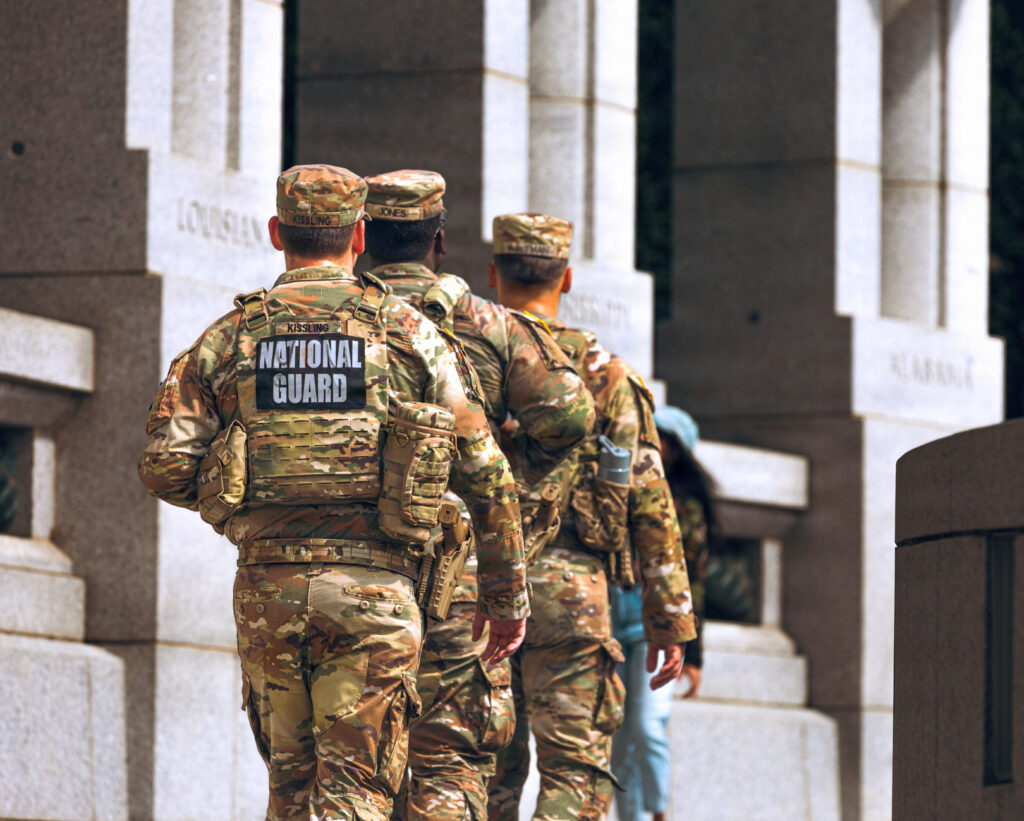
The surge started with 800 Guard members and grew to about 5,000 in July during the nation’s 250th anniversary celebrations. In mid-July, the Defense Department confirmed that Trump intended to extend the mission through the last day of his term, Jan. 20, 2029.
As of Oct. 4, there were 2,866 troops in D.C., according to the Joint Task Force-District of Columbia.
At the outset of the deployment, the White House asserted that crime was “out of control” in D.C., which it said had “the fourth-highest homicide rate in the country.”
That ranking came from a Rochester Institute of Technology study that compared the city in upstate New York, population 206,000 – less than a third of D.C. – to 23 other selected cities, all but six of them smaller than D.C. Only four of those cities saw their homicide rates drop more than D.C. between 2023 and 2024.
Richard Hahn, a criminal justice researcher at the Niskanen Center, a free-market think tank that has studied the deployment, said the use of such statistics paints pre-deployment crime in D.C. as more dire than reality.
“They’re sort of like picking and choosing what window of analysis they’re looking at,” he said.
White House defends deployment
The White House defends the ongoing Guard deployment and its characterizations of the city.
“President Trump has transformed our nation’s capital from a crime-ridden city into a safe and beautiful haven for residents and visitors alike,” said Lauren Bis, a White House spokeswoman, by email to The Beam, responding to a query about whether the deployment has been cost-effective and for evidence linking it to the drop in crime. “The Task Force has driven down crime, beautified the city, and improved quality of life for countless individuals.”
There is no dispute that overall crime in D.C. has dropped during the deployment.
In the first 12 months, violent crime dipped 13%, according to MPD data. Homicides were down 44%, though killings were already plunging – from 274 in 2023 to 187 in 2024.
“You should be thankful for me, for what my administration and I have done to make our nation’s capital, which was one of the most dangerous and unsafe cities anywhere in the world, one of the safest cities in the United States,” the president told the audience at the black-tie correspondents’ dinner on July 24. “Two years ago, we lived in a dangerous city.”
The homicide count in 2025 was 126 – all but 29 of them before the troop surge began on Aug. 11, MPD data shows. That’s unusual. In the previous five years, homicides were spread more evenly before and after Aug. 11 – supporting the White House narrative that the intervention has made a difference.
Nationwide trends
The Niskanen Center estimated that the federal intervention pushed down “opportunistic property crime” by 24% during its first six months, but with “no measurable effect on violent crime.”
Ongoing improvements in most major crime categories has tracked nationwide trends.
For critics, that casts doubt on claims linking the deployment to safer streets in the capital.
The liberal Center for American Progress issued an analysis 11 months into the deployment finding no evidence it reduced violent crime.
Trump called the findings “crazy” and a “Radical Left SCAM” in a Truth Social post. His lawyers threatened a $5 billion defamation lawsuit unless the group retracted the report. The group refused.
FBI data released Aug. 14 showed a 9.7% drop in the violent crime rate nationwide in 2025 – the largest year-to-year decline since 1936, when the bureau began issuing national estimates.
The White House credited Trump’s “law and order policies.”
David Muhammad, executive director of the National Institute for Criminal Justice Reform, a group that advocates for reduction in both violence and incarceration, said the widespread drop in crime suggests that troops have made little meaningful difference in D.C.
He pointed to Oakland, California, where shootings declined for more than two years, as an example of a city where violence subsided without a military presence.
FBI data analyzed by The Beam show Oakland’s homicide rate fell 33% from 2024 to 2025, while its robbery rate dropped 42%. Chicago, Indianapolis and San Francisco, among others without federal troops, showed similar improvements in violent crime.
‘Visibility’
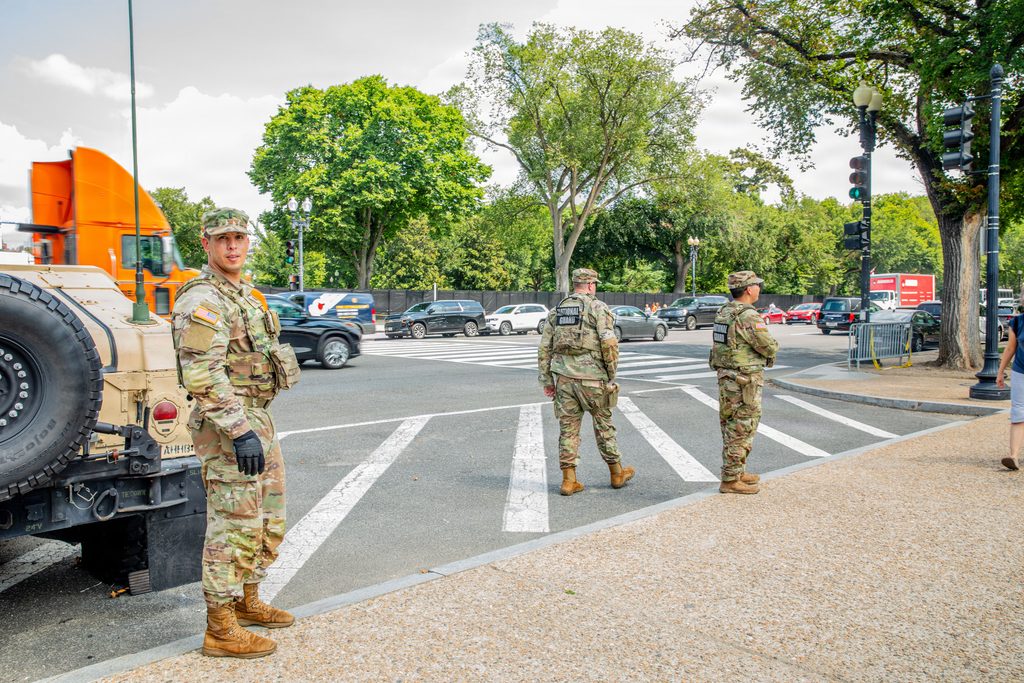
One reason for skepticism about the impact of the Guard stems from where they have been deployed – mostly in areas tourists see. That includes national monuments, the National Mall and major Metro stations, rather than neighborhoods where crime is most prevalent.
A Reuters review of D.C. Superior Court records found little evidence of Guard involvement in law enforcement in the neighborhoods where most homicides occurred.
“Their deployment locations were chosen for visibility and symbolic significance, and much of their work was not related to law enforcement,” the Niskanen report said.
Guard members were deputized as U.S. marshals but have limited law-enforcement authority. They don’t make arrests, though they can detain suspects until police or federal agents arrive.
At times, they have been assigned to clearing brush and picking up trash.
The National Guard has declined to provide details on where troops have been deployed or for how long. In a statement to The Beam, a spokesperson for the Joint Task Force-District of Columbia said troops are deployed “across all eight wards of the District.”
Brig. Gen. Leland Blanchard, interim commanding general of the D.C. National Guard, addressed the issue shortly before the Aug. 11 anniversary.
Putting Guardsmen in more visible locations “allows them to displace” MPD officers so local police can “focus in other areas.” He also asserted that his troops are in parts of the city known for elevated crime.
“We’ve been in Anacostia for quite some time,” he told reporters. “Over the last few days, I know there’s been some reporting and some interest in Ward 8, Trinidad, and some of the other parts of the city where people have asked us to be.”
Complicated picture
A key reason that critics have questioned the justification for a troop deployment is that crime in D.C. had been dropping for a decade.
The aggravated assault rate fell more than 30% from 2016 to 2025, more than any other major city but Chicago.
A Beam analysis of FBI crime data shows that rape fell by more than 60%, the largest decline among the 25 largest U.S. cities.
Robbery and homicide rates were also lower in D.C. at the end of that decade, though both spiked in 2023 – homicide surged 35% that year – temporarily driving up the overall violent crime rate.
But with crime continuing to ease, critics say the case for an ongoing military presence is getting weaker.
Since the spike in 2023, Hahn said, “D.C.’s crime has fallen at a rate faster than the rest of the country. So, we were worse than the rest of the country, but we’re also improving much more quickly than the rest of the country.” And, he said, “Most of this decline predates the National Guard deployment.”
The picture is complicated, though. D.C. crime has dropped further since the deployment began but aggravated assault rose sharply – 29% – in the first 12 months, according to MPD data.
Timeline and cost
The federal government has not issued a definitive cost projection for the D.C. deployment.
Based on estimates from the Defense Department comptroller and the nonpartisan Congressional Budget Office, the cost from the start until Inauguration Day 2029 will be about $2.1 billion, assuming an average daily force of 2,500 for the final 15 months.
In Hahn’s view, the costs outweigh the benefits.
“We didn’t sort of get the payoff that we should have gotten from, you know, how much we spent on the Guard,” he said.
Robert Gonzalez, a Georgia Tech economist who published a cost-benefit analysis in April, said the deployment achieved some crime reduction – but at an extremely high cost compared to alternatives.
Gonzalez said the impact the Guard deployment has had on crime could have been achieved “at a fraction of the cost” through local violence-intervention efforts.
At Peace for DC, a nonprofit focused on gun violence prevention, executive director Chandra Dawson also said she sees more bang for the buck with a community-based approach.
Her group provides violence intervention training, job and education coaching and life skills classes in neighborhoods affected by gun violence. In spring 2025, it lost $1.4 million from a $2 million grant when the Justice Department canceled about $500 million in public safety grants, affecting more than 200 organizations.
“There is no evidence. There is no proof,” Dawson said. “There is nothing credible that suggests the presence of National Guard has a direct correlation to any decrease in crime whatsoever. Especially within – my space is gun violence. There’s no evidence there at all.”
Evan Wyloge, a data journalist for The Beam, contributed to this story.