



By Katie Wilcox
The Arizona State Board of Education voted Monday to raise the proficiency and growth targets that determine schools’ A-F letter grades, which are published on the state’s AZ School Report Card. Under the new targets, more students will have to pass state standardized tests for a school to earn an A.
In July, The Beam revealed that many A grades went to public high schools in Arizona where a large majority of the students failed to meet the state’s proficiency standards. In some cases, 11th-grade proficiency scores decreased even as a high school’s letter grade improved.
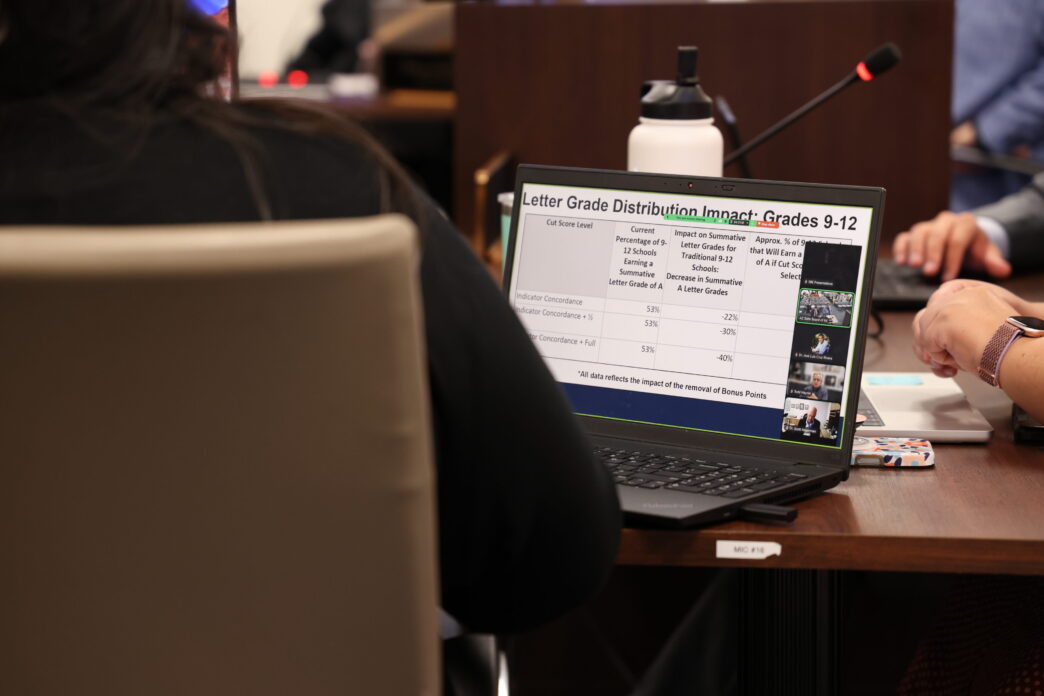
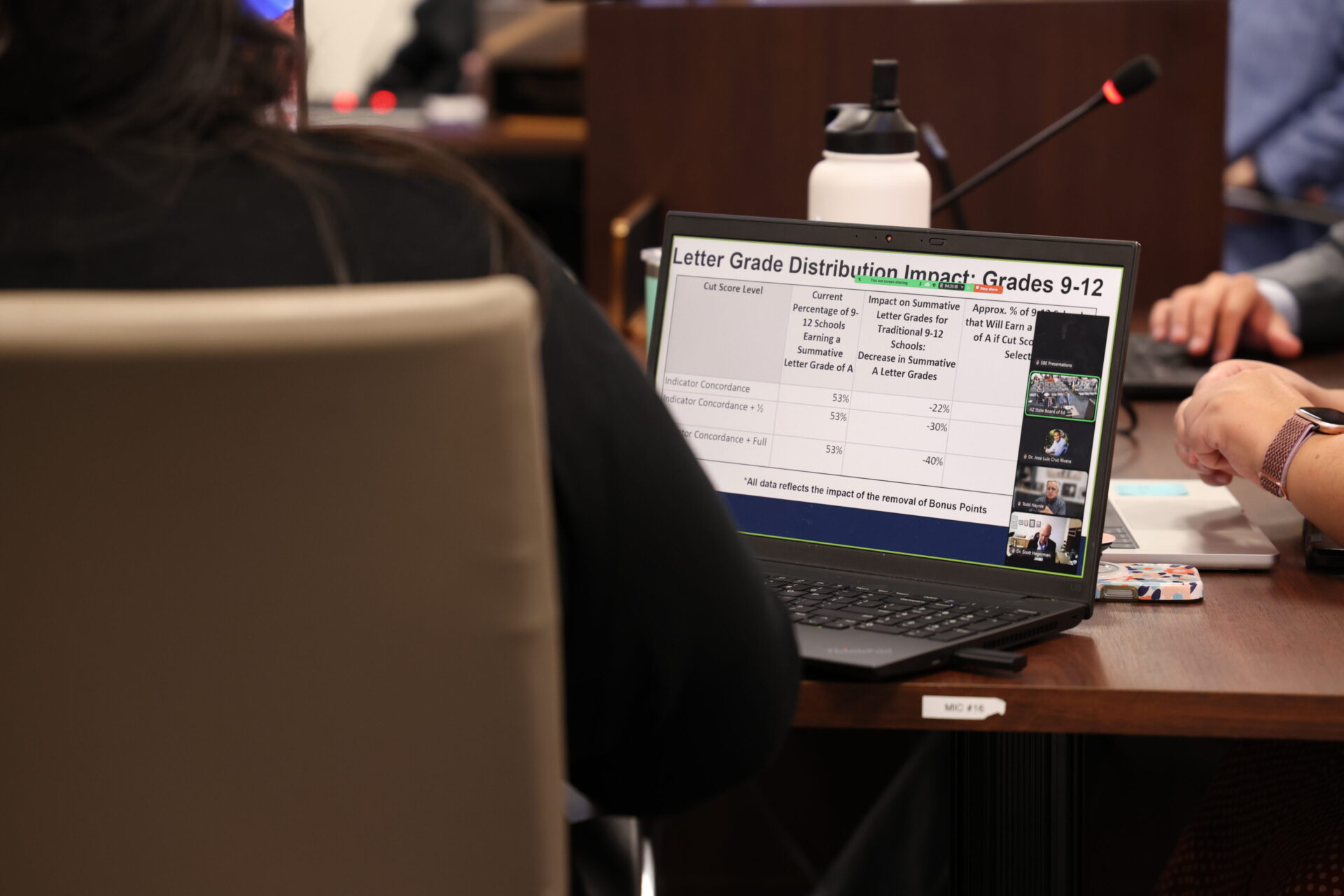
The new standards the board approved this week could mean 50 Arizona high schools would lose their A grades, according to an analysis by the Arizona Department of Education.
In 2025, 60% of 11th graders failed to meet the state proficiency standards in English language arts, and 70% failed to meet the standards in math.
Sean Smith, the education department’s chief accountability officer, prepared an analysis for the board and said the decision would result in fewer schools receiving A grades and more receiving C, D or F grades.
Monday’s vote is part of a larger overhaul of the A-F letter-grade system, which assigns ratings for all public schools in Arizona, including charter schools.
It does not apply to private schools, including those receiving state tax dollars through Empowerment Scholarship Accounts.
Public schools are rated based on a series of criteria, including student proficiency on tests, student growth, proficiency for English learners and other measures for different grade levels, including graduation rates for high schools.
The Beam examined state data and found a wide gap between the number of students who graduate each year and the number who meet academic standards. In 2025, 80% of Arizona high school students graduated, despite a majority failing to meet state proficiency standards in 11th grade.
In June, the Arizona Auditor General released a report criticizing the system for “potentially inflating schools’ letter grades” with bonus points and for giving top scores to schools “even when very few students demonstrate proficiency.”
In August, the state board voted to eliminate bonus points, the first of two major actions so far that the state board has taken to reform the letter grade system.
The takeaways:
- Under the new rules, public schools must have more students meet state proficiency standards to get top ratings in both proficiency and growth categories.
- Fewer schools are expected to receive A grades.
- Schools will receive multiple letter grades: one for each indicator plus an overall grade.
The changes apply to the 2026-27 school year, and the board is expected to vote on additional changes to the school letter-grade system in the coming months – a concern for educators and advocates who asked the board for caution ahead of the vote.
Adam Schwartz is executive director of school leadership at the Tolleson Union High School District, a district with a Title I designation for its large concentration of low-income students. He warned the board at the meeting that its vote could disadvantage low-income schools.
“Families from some of our most economically challenged communities may not be in this room today. They may be working, unable to leave their jobs or facing transportation or language barriers. Their absence cannot be mistaken for an absence of concern,” Schwartz said. “If Arizona wants a higher bar, let’s have that conversation. Let’s examine the evidence, consider the consequences and establish the new standard. Then tell every school where the finish line is before the race begins.”
Schwartz was joined by additional members of the Tolleson Union High School District administrative team, who echoed his concerns. Wendy Davy, the district’s director of educational data and innovation, said raising the proficiency target is unfair.
“We deserve recognition for more than our poverty rates and our ZIP code,” Davy said. “You just have to have a system that’s fair and equitable to everybody. That’s all we ask. We’re not afraid of accountability.”
Several board members acknowledged concerns about “unintended consequences” that could result from increasing the proficiency target. Sean Ross, the board’s executive director, reminded the board during the meeting that state data has shown a strong correlation between poverty and proficiency.
He said that before legislative changes in 2016, letter grades were based primarily on proficiency, resulting in lower ratings for lower-income schools.
“What that model was reporting back was maybe less about how schools were performing and more about the socioeconomic status of their students,” Ross said.
The Beam analyzed state data and found that low-income students were half as likely as their peers to pass state standardized tests in 11th-grade math and English language arts.
Angela Philpot, vice president of the Arizona Education Association, warned that lower letter grades could make it even harder for schools to get the resources they need to improve.
“When a school gets a D or an F, it has a harder time hiring the teachers it needs the most. The grade doesn’t help that school improve. It punishes it,” Philpot said, adding that she hopes schools will get additional help if they receive lower grades. “When a school struggles, send support before sanctions.”
The changes to the letter-grade calculations could also affect the state’s charter schools. Kelly Powell, director of research and evaluation at the Arizona Charter Schools Association, asked the board at the meeting to be cautious in its decisions.
“For Arizona’s public schools, state accountability has consequences,” Powell said. “How and if a charter school will be able to carry on doing its job serving Arizona citizens rests on these grades.”
State law requires intervention, which could include revoking a charter school’s charter, if it receives an F or three consecutive D grades.
“Decisions you make on proficiency and growth today will impact how other components are considered and ultimately how the overall composite letter grade is computed,” Powell said. “Please be cautious in your decisions going forward.”
Beginning in October 2027, the state will release grades for each indicator in addition to the school’s overall letter grade.
The board is expected to reevaluate additional indicators, including college and career readiness, graduation rates and English learners, in upcoming meetings beginning in October.
Ross, the board’s executive director, acknowledged that these decisions will decrease the number of top-rated schools in Arizona, but he said schools will adjust.
“There will initially be a decrease in letter grades, particularly in A’s, but I believe in schools,” Ross said. “I think when you raise the bar, schools work to meet that bar, and so that’s why I’m stressing initially, there’s still very much a chance for every school to earn an A within this system.”
The board voted to adopt the proficiency and growth revisions for one year and will reevaluate the changes next year.
The Beam intern Ava O’Keefe contributed to this reporting.