



By Grant Johnson, Lex Doig and Lavanya Paliwal
Just before Sadie Shaw’s daughter started her first day at Dodge Traditional Middle Magnet School in Tucson last year, her daughter’s math teacher abruptly resigned. A long-term substitute stepped in. Then another. Then another. A math teacher from the grade above coached the subs as they rotated through.
Shaw has another vested interest in solving the teacher shortage in the Tucson Unified School District — she sits on its governing board. Her daughter’s teacher left the district before the start of the 2025-26 school year. At least 8,523 educators exited Arizona public schools between the last two academic years. That’s a loss nearly three times greater than the number of new teachers certified to replace them.
To keep classrooms staffed, districts across Arizona are signing contracts with private staffing companies and paying invoices in taxpayer dollars. The arrangement is used nationally — it keeps schools open and teachers in the classroom. But it also raises a difficult question: as private companies generating billions in revenue nationally move into a captive market, how much of that public money actually makes it to the educators standing in front of Arizona’s students?
An investigation by The Beam and Cronkite News found the teacher and staffing shortage in Arizona has attracted investors who found a valuable market. Cash-strapped districts pay top dollar to fill gaps with teachers, psychologists, therapists and other specialists schools can no longer recruit on their own. The result: public money meant to reach students is flowing to private staffing companies that report billions in annual revenue.
- Arizona school districts are paying private companies nearly $80,000 per teacher per year in taxpayer dollars, and often have no idea how much of that money reaches the teacher.
- The company supplying teachers to nearly a quarter of Arizona’s public schools is tied to a multibillion-dollar staffing empire founded by the majority owner of the Baltimore Ravens.
- Arizona districts are relying on alternative staffing to mitigate the shortage. Rising visa costs for international teachers, who fill some staffing gaps for Arizona schools, could make shortages worse and push districts to rely more heavily on staffing companies.
A revolving door
Arizona public schools began the 2025-2026 school year short on teachers, and not by a small margin. In October 2025, the Arizona Department of Education (ADE) reported 4,379 vacancies across all counties, with school districts in Maricopa County accounting for the largest share at 2,500 vacancies. Superintendent Tom Horne said the teacher shortage in the beginning of the 2025-26 school year remained in “a catastrophic state.”
The problem did not arrive overnight. Many districts began recruiting six months before the start of the school year, but they still had to rely on contracted agency or vendor personnel to fill at least 731 full-time equivalent positions because traditional hiring methods were not enough, according to the ADE.
Those vacancies are fed, in part, by a documented problem with retaining public school teachers.
Between the last two school years, nearly one in five Arizona teachers either left the profession or moved to a different local education agency. A total of 8,523 teachers, 14% of the workforce, exited Arizona public schools entirely in a single year.
When traditional hiring fails, the district turns to private staffing agencies and international hires to place qualified teachers in classrooms.
The price of filling the gaps
Tucson Unified School District (TUSD) knows the cycle well. The district has for years faced a shortage of teachers, with middle and high school math positions among the hardest to staff. The district prioritizes employing long-term substitute teachers and internal staff before seeking a contracted teacher, but it often struggles to provide consistent and highly qualified personnel for its students.
“It’s not a question of subs not taking these jobs, they’re taking them on a daily basis, weekly basis, on a multi-day basis,” Superintendent Gabriel Trujillo of TUSD said during a school board meeting held Sept. 24, 2024. “That is not what the students need. They need a full-time highly qualified teacher to take it for the year.”
The district employed six contracted general education teachers for the 2024-2025 school year, a number that doubled for the 2025-2026 school year.
Amergis Educational Staffing works with nearly a quarter of all Arizona public schools, including Tucson Unified. The company charges districts a flat rate: For Tucson, that cost is $58/hour for a contracted general education teacher. At 7.5 hours a day over a 180-day school year, the district pays Amergis $78,300 per teacher, per year.
Hiring through Amergis costs the district more than putting a teacher on its own payroll. TUSD’s 2025-26 salary schedule lists starting pay for a classroom teacher at $48,400. The district budgets 32% of salary for employee-related expenses, including benefits, bringing the total cost of a non-contracted starting direct hire to approximately $63,888.
Amergis recruiting posts for the 2025-26 school year advertised starting pay of $33 an hour for a kindergarten teacher — the same year TUSD paid $58 an hour for two kindergarten teachers at Vesey Elementary and Hollinger K-8. Listings on the Amergis website for the 2024-25 school year showed a seventh-grade teacher position starting at $35 an hour; TUSD paid $58 an hour for two seventh grade teachers at Hollinger K-8 that same year. A fourth-grade position for the 2024-25 school year was listed at $32 an hour; TUSD paid $58 an hour for one fourth grade teacher at Erickson Elementary.
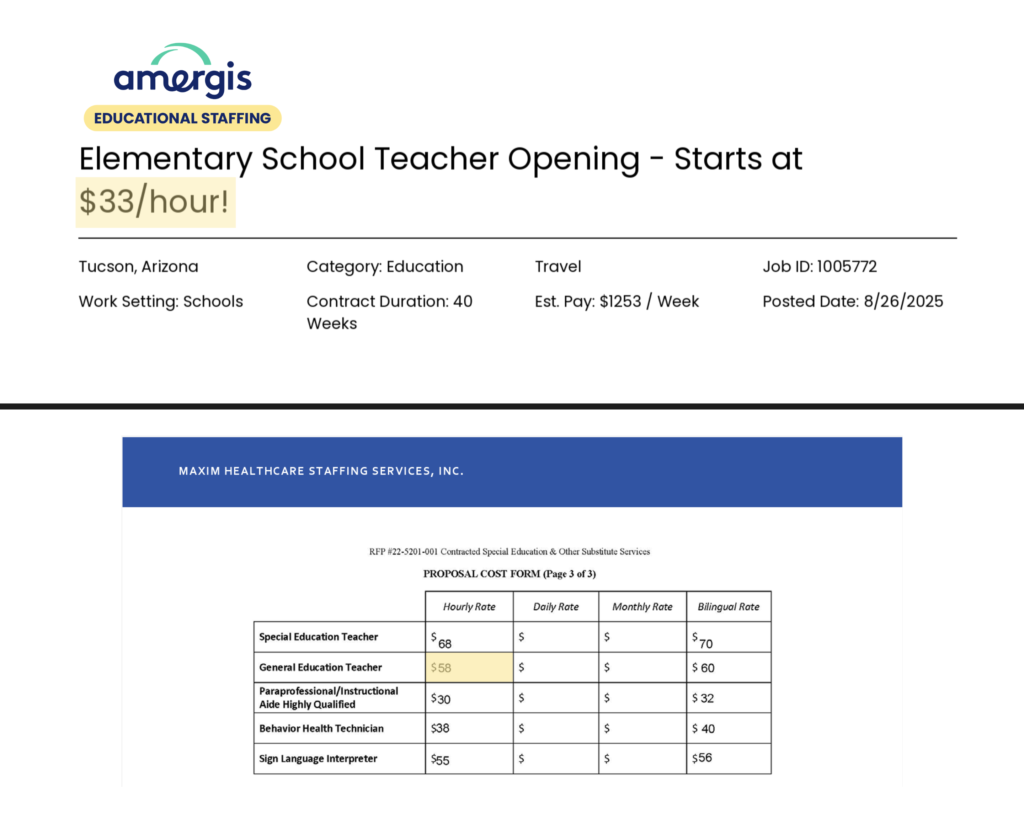
In each case, the district absorbed a gap of at least $23/hour between what Amergis advertised to teachers and what it billed to TUSD.
When asked to clarify in concrete terms how districts receive visibility into pricing, Amergis did not answer the question. Instead, the company reiterated that its all-inclusive rate covers recruiting, credentialing, background checks, payroll and benefits administration, calling these “standard, widely used practices in education staffing.”
When presented with the $25/hour figure specifically, Amergis did not directly address it, saying compensation “is contract-specific and can vary by district and position” and that it could not provide a figure representing a single compensation rate.
TUSD typically funds these services through savings accrued from unfilled permanent positions. This approach may sometimes end up costing them more than if they hired directly, due to administrative fees and vendor markups.
Shaw, who has served on the governing board since January 2021, is an outspoken critic of the district’s growing reliance on contracted teachers.
“I feel like we vote on this almost every board meeting,” she said during a TUSD governing board meeting in August 2022. “We keep kicking the can down the road by getting these contracted teachers.”
In 2026, her position on contracted general education teachers has not changed.
“It’s either we hire a contracted teacher who does get paid slightly more than our regular teachers do, or we subject the students to a long-term substitute who may not be as qualified as the contracted teachers would be,” she said. “So unfortunately, it’s a necessary evil that TUSD and other school districts have to grapple with because there’s a teacher shortage nationwide.”
“I still think we’re kicking the can down the road,” she said.
The money to be made from public education
TUSD is far from alone in turning to outside vendors, and the companies supplying those teachers have taken notice.
Several healthcare staffing companies have expanded their business models to provide school districts with teachers, a transition made easier as schools’ need for special education teachers, speech therapists and behavioral specialists overlapped with the services they already provided.
“It’s a bit of a tipping point where the market got large enough for healthcare professionals to schools that some of the healthcare staffing firms decided to see it as a kind of a business line where they would hire specialized recruiters and staff,” said Timothy Landhuis, senior vice president of research at Staffing Industry Analysts (SIA). His firm studies staffing and workforce solutions and published an Education Staffing Market Overview in October 2025 that studied the market of healthcare staffing companies getting into education staffing.
“I think companies see the opportunity. Education does have the advantage of a lot of times, you might have a school year or a 12-month type contract for the worker,” Landhuis said. “So that’s attractive as well.”
Assignments in other segments of the staffing industry can run as short as three months, or even a single shift, Landhuis said. Education contracts, which can last up to a year, give staffing firms more time to recover the cost of recruiting and placing a worker.
One company that has moved aggressively into that opportunity is Amergis Educational Staffing Services. In 2024, Maxim Healthcare Staffing, a healthcare staffing company, changed its name to Amergis and expanded its brand to include education staffing under Amerigs Educational Staffing. Gregory Steiner, a senior vice president of operations at Amergis, listed on his LinkedIn profile that the company generates $1.8 billion in annual revenue. It’s unclear what portion of the company’s revenue comes from educational staffing alone.
In Arizona, the company has worked with approximately 59 school districts since 2025. A proposal Maxim Healthcare Staffing submitted to Dysart Unified School District included a resume for a Maxim executive that said the company’s western region, which includes Arizona and four other states, generated approximately $140 million in annual revenue. Amergis declined to clarify what portion of that figure reflected education staffing versus healthcare services, and did not provide current revenue figures.
Amergis grew out of Maxim Healthcare Services, which was incorporated in Maryland in 1988. Public incorporation records from the Maryland State Department of Assessments and Taxation show that Allegis Group submitted payment for an amendment to that incorporation in 2006. Two of the three directors listed for Maxim were James (Jim) Davis, and Stephen (Steve) Bisciotti. The two cousins are co-founders of a firm that grew into Allegis Group. Davis also founded Redwood Holdings, and Bisciotti is majority owner of the Baltimore Ravens.
In 2022, Maxim began to lay the groundwork for its move into the education space, splitting its home healthcare and staffing divisions into different companies. Maxim’s staffing branch was renamed to Amergis, the same year it registered the trade name Amergis Educational Staffing.
In a statement to reporters, the company said Amergis, Allegis Group, Maxim Healthcare and Redwood Holdings “operate as separate entities.”
In March 2025 written testimony submitted to the Maryland General Assembly, a lobbying group called Allegis Redwood Maxim Public Affairs, wrote that Allegis Group, Redwood Holdings, Maxim Healthcare and Amergis together form a “family of companies” that is “the largest privately held company headquartered in the state of Maryland.”
Bill Butz, the CEO of Amergis Healthcare Staffing, served as CFO of Allegis Group from 1995 to 2010, according to his LinkedIn profile. Scott Carter, Amergis’ CFO, spent a decade at Aerotek, one of Allegis’ founding companies, before joining Amergis.
In 2025 Staffing Industry Analysts ranked Allegis Group as the largest staffing firm in the United States, with $9.3 billion in revenue and 5% of the market.
“When I first started in this business 20 years ago, ESI was like the one,” said Hernandez. “It’s just ballooned into all of these other companies that are providing third-party workers, not just in the classroom, but outside the classroom, too, paraprofessionals and professionals and administration and things like that.”
Big districts are not the only ones feeling the pressure.
“It is getting harder and harder to find a certified teacher and especially in some of the content areas at the high school,” said Holbrook Unified School District Superintendent Robbie Koerperich. “It’s market conditions. If you have a market where you are required to have someone or a product, what do you do? You got to have it.”
Koerperich said he does not fault teachers who choose to work through staffing agencies, saying “they’re probably making what every teacher should be making.”
“They’re probably making $70,000 to $80,000 a year or more to teach math or science or whatever it might be. But, you know, if we could do that for everybody, then we wouldn’t have a market.”
For Huitt, the market built on desperation that Koerperich describes points to something more fundamental than a staffing problem.
“It’s like it’s a Band-Aid,” she said.
“It’s really important for us to prioritize how we fund education,” Huitt said, saying low pay for educators is exacerbating the issue. “If we could take a look at that as a state, I think it would be valuable. And then we wouldn’t have the need to have a stopgap solution for emergency situations.”
Huitt said the post-COVID years were the worst of it, but the district is still relying on the agencies to find certified teachers. “It’s a little bit better now,” she said.
When a position opens, the agencies move fast. According to Huitt, candidates are typically identified within 24 to 48 hours. After a candidate interviews directly with the school principal and both sides agree on the fit, the teacher can be in front of students within about a week, completing onboarding with the agency rather than the district.
According to Ricky Hernandez, the chief financial officer at TUSD, the teachers are on the vendor’s payroll, not the district’s.
“We get an invoice that tells us, you know, this is how much Teacher X at this school is being paid,” said Hernandez. “We would know what the going rate is based on whatever the contracted amounts are, because we know that obviously these are businesses. They have to make a profit.”
Districts are already spending heavily to keep classrooms staffed, but the costs may soon climb further. Many areas have often relied on teachers recruited from overseas to fill vacancies, but changes to the H-1B visa process under President Donald Trump threaten this tenuous system.
Without this stopgap measure to slow the shortage, contracted teachers could be one of few options public schools have left.
International teachers and the visa clock
At Indian Oasis Intermediate School in Sells, a fourth-grade teacher packs up his classroom after five years. His contract is ending not because he wants to leave, but because his visa requires it.
Cerelo Flores is one of 10 international teachers from the Baboquivari Unified School District —on the Tohono O’odham Nation — who have submitted resignation letters in advance of their program expiration. The Intermediate School will have lost 50% of its staff at the end of the academic year, according to Ruben Diaz, the superintendent of Baboquivari Unified School District.
Across Arizona, scenes like this are quietly repeating. As of the 2025 fiscal year, there were 444 teachers initially certified to teach on an International Teaching Certificate, according to data from the Arizona Department of Education. Nationally, 6,855 teachers hired from overseas were working at pre-K, primary or secondary schools in the United States during the 2024-25 academic year, according to Bridge USA, which oversees international work exchange programs through J-1 visas. Nearly 45% of them were hired from the Philippines.

Hiring internationally used to be a simpler solution to a complex problem: teachers hired on these visas are paid comparable salaries to U.S.-based educators.
International teachers are typically hired on one of two visas: the J-1, which has a base period of three years and can be extended up to five years; and the H-1B, which has a base of three years and can be extended up to six.
Both visas were good options for districts that were short on qualified professionals, and in the 2025 fiscal year, there were 444 international teaching certificates issued in Arizona. But on Sept. 19, 2025, Trump issued his proclamation “Restriction on Entry of Certain Nonimmigrant Workers,” which required a $100,000 payment to be issued an H-1B visa.
Diaz said they began to turn to international teachers to fill gaps during the COVID-19 pandemic. Though even then he preferred the H-1B visas, he never insisted upon using them exclusively, a choice he now regrets.
“Unfortunately, with the J-1 visa, by the end of their serving term, they have to go back to the Philippines. And this is now the situation,” Diaz said.
“Now I don’t have $100,000 for every teacher that wants an H-1B.”
Districts can hire teachers applying for visas directly from overseas, or they can use certain staffing companies as an intermediary — hiring from a pool of candidates using these companies to facilitate the visa process.
On Aug. 11, 2025, Liberty Elementary School District approved an agreement with Teach in the USA LLC, a Michigan-based company that facilitates J-1 visa “Cultural Exchange Programs” and H-1B recruitment.
For teachers on J-1 visas, the district will pay the teachers their salaries directly, and then pay additional fees to the staffing agency that can be as high as 25% more for some teachers. H-1B visas require a $5,000 payment, with an optional $2,500 per quarter for mentorship and professional development services. Those fees are in addition to the new $100,000 fee.
“We have hard to fill positions that are in need of qualified teachers in front of them and a charge that I take very seriously is that we want to put qualified people in front of them. No matter what. However that looks,” Trevor McDonald, then interim superintendent of Liberty Elementary School District, said in the board meeting where the agreement was approved.
The district did not comment on the former interim superintendent or the agreement with Teach in the USA in an email to The Beam.
“At this time, the District does not wish to respond to the questions,” wrote Erica Avila, acting assistant superintendent of Human Resources and Student Services.
McDonald said the costs of U.S. contracted teachers “usually come at a price tag of two-to-one,” making international teachers more broadly affordable.
Flores paid International LLC $6,400 for his three-year J-1 visa exchange program. The cost breakdown includes sponsor and application fees, embassy schedule assistance, travel expenses, U.S. teaching certification and assessment and review services.
“While this letter fulfills the formal requirements for staffing and recruitment, please know it [is] written with gratitude, reflection, and genuine hope for whatever the next chapter may bring,” Flores said in his resignation letter.
“I am not losing hope that one day, after the completion of my 212(e) residency requirement, I may have the opportunity to once again work alongside all of you and continue serving this remarkable school community.”